Venice is a city in northeastern Italy and the capital of the Veneto region. It is situated on a group of 118 small islands that are separated by canals and linked by over 400 bridges.
Table of Contents
Venetian Carnival in Front of San Giorgio Maggiore

The Venetian Carnival: Masks and Tradition
The Venice Carnival 2027 runs from January 30st to February 9th, 2027
During the Venetian Carnival, Venice returns to a tradition that dates back to the 18th century, when the celebration was at its peak. At that time, the carnival lasted for several months, allowing people of all social classes to mix freely behind masks and elaborate costumes. Masks played a central role, offering anonymity and temporarily erasing social boundaries.
The carnival was banned at the end of the 18th century and disappeared for nearly two centuries. It was revived in the late 20th century, largely as a cultural and tourist event, and has since become one of the city’s most famous annual celebrations. Today, the dates of the Venetian Carnival change every year, as they are linked to the liturgical calendar and the period leading up to Lent. While masks remain iconic, modern celebrations also highlight richly decorated costumes, performances, and historic Venetian settings.
San Giorgio Maggiore Island
Designed by Andrea Palladio in the 16th century, the San Giorgio Maggiore church is a masterwork of classical harmony, its white façade standing in sharp contrast to the shifting lagoon. The Campanile offers a panoramic perspective where canals, domes, and rooftops align with remarkable clarity. The island also hosts an open-air theater, where performances are occasionally staged against the backdrop of the lagoon. San Giorgio Maggiore is less about spectacle than proportion and calm — a place where architecture, light, and water come together to reveal Venice at its most timeless.
Rialto Bridge and Grand Canal

Rialto Bridge
The Rialto Bridge is one of the most iconic landmarks in Venice and the oldest crossing of the Grand Canal. Before the current stone bridge was completed in 1591, several wooden versions stood here, some of which collapsed under the weight of crowds and shops.
The name Rialto comes from the Venetian Rivo Alto, meaning “high bank,” referring to one of the first areas of the city to be settled. Today, the bridge is instantly recognizable for the small shops built directly onto it, a tradition that has existed for centuries and once housed merchants and traders.
Grand Canal
Flowing beneath it, the Grand Canal is Venice’s main waterway, often compared to the central avenue of a great city. It curves through Venice in an S-shape and is crossed by only four bridges: Rialto, Accademia, Scalzi, and the modern Constitution Bridge. From the Grand Canal branch dozens of smaller canals, known as rii, which penetrate deep into the city’s neighborhoods.
Flowing beneath it, the Grand Canal is Venice’s main waterway, often compared to the central avenue of a great city. While it is constantly bustling with expensive private water taxis and delivery boats, the vaporetto remains the most practical way for a visitor to enjoy the view of the palazzi. It curves through Venice in an S-shape and is crossed by only four bridges: Rialto, Accademia, Scalzi, and the modern Constitution Bridge.
From the Grand Canal branch dozens of smaller canals, known as rii, which penetrate deep into the city’s neighborhoods. Another major water route, the Giudecca Canal, runs parallel to the historic center and plays an essential role in navigation and maritime traffic.
Piazza San Marco (St. Mark’s Square)

Piazza San Marco (St. Mark’s Square) is the most famous square in Venice and the only one traditionally called a piazza rather than a campo. Often the first area to experience the Acqua Alta high tides due to its low elevation, it is as renowned for its architectural landmarks as for its pigeons, long fed by visitors and inseparable from the square’s image. For centuries, it has been the ceremonial, religious, and social heart of Venice, a place where daily life and public spectacle have always coexisted.
The square opens toward the lagoon through the Piazzetta San Marco, creating a rare sense of openness in a city otherwise defined by narrow streets and canals. At its eastern end stands St. Mark’s Basilica, with its Byzantine-inspired domes and golden mosaics, built to house the relics of Saint Mark brought to Venice in the 9th century. Directly adjoining the basilica is the Doge’s Palace, the former seat of Venetian political power—connected to the New Prison by the famous Bridge of Sighs—while opposite rises the Campanile, rebuilt after its collapse in 1902 and still the tallest structure in Venice.
Framing the square are the Old and New Procuratie, whose long arcaded façades give Piazza San Marco its distinctive rhythm. Beneath them are historic cafés, including Caffè Florian, founded in 1720 and considered the oldest café in Europe, and Caffè Quadri, which dates back to the Austrian occupation. These institutions have long been places of observation and social life, reinforcing the square’s role as both a symbolic and lived-in space at the heart of Venice.
Gondola in Burano

Gondola
The gondola is one of the most recognizable symbols of Venice, designed specifically for navigating the city’s narrow canals. Its distinctive asymmetrical shape helps it move smoothly through the water when rowed by a single gondolier.
While gondolas were once the primary means of transport for Venetians — with thousands in use across the lagoon — their number has dramatically decreased over time. Today, they are used almost exclusively for tourism, with the notable exception of the traghetto, a simpler gondola that still carries residents across the Grand Canal at specific crossing points. Since the 16th century, gondolas have traditionally been painted black, a rule imposed to limit excessive ornamentation among wealthy families.
Burano Island
Burano, located in the Venetian Lagoon, is one of several islands that form the historic constellation of Venice. It is widely known for its brightly colored houses, although many other islands contribute to the city’s unique character. Just next to Burano lies Mazzorbo, connected by a wooden footbridge, while nearby Torcello preserves some of the earliest traces of settlement in the lagoon. Closer to Venice, Murano is famous for its glass workshops, and San Michele, the city’s cemetery island, occupies a unique place in the lagoon’s geography and history.
Rio della Madonna dell’Orto nel Cannaregio

Located in the Cannaregio district, the Rio della Madonna dell’Orto reveals a quieter and more residential side of Venice, far from the busiest tourist areas. Cannaregio lies just beyond Venice’s railway and road gateways, making it one of the first districts encountered when entering the city. The canal takes its name from the nearby church of Madonna dell’Orto, where Tintoretto (1518–1594) is buried. Born Jacopo Robusti, he was nicknamed Tintoretto, meaning “little dyer,” in reference to his father’s profession. He is considered one of the most famous Venetian painters, alongside Titian (Tiziano Vecellio), Veronese (Paolo Caliari) and Canaletto, and a central figure of the Venetian Renaissance.
Cannaregio is also historically significant as the location of the Venetian Ghetto, established in 1516, from which the very word “ghetto” originated before spreading to many other languages. The district is one of Venice’s six historic sestieri, along with San Marco, Dorsoduro, San Polo, Santa Croce, and Castello. These six districts are traditionally symbolized by the six forward-facing teeth on the ferro, the metal prow of a gondola. Lined with modest palazzi and narrow fondamente such as Fondamenta Gasparo Contarini, the rio connects to a dense network of smaller canals that shape everyday Venetian life.
Rio dell’Arsenale, Castello District

The Arsenale was the military engine of the Venetian Republic, a shipyard so efficient it could assemble a warship in just twenty-four hours. This vast industrial complex made Venice the dominant naval power in the Mediterranean for centuries. Walking along the Rio dell’Arsenale leads into the Castello district, where the scale of the city subtly shifts.
The two fortified towers guarding the water entrance are among the most recognizable landmarks in this quieter part of Venice. Much of the Arsenale remains an active naval base, preserving a rare sense of stillness and historical gravity. Far from the crowds of Rialto and San Marco, Castello feels authentic and lived-in. Wide canals and massive brick walls offer a glimpse into the sheer power of a former maritime empire. It is an essential detour for anyone seeking to understand the engineering ingenuity and strategic vision that allowed Venice to thrive for more than a thousand years.
Giudecca Island

Giudecca lies just across the Giudecca Canal from central Venice, yet feels markedly different in pace and atmosphere. Long and narrow, the island has long been associated with craftsmanship and everyday Venetian life. Its skyline is defined by the Church of the Redeemer (Il Redentore), designed by Andrea Palladio in the 16th century, a landmark of Renaissance clarity and restraint.
At its western end, Giudecca is connected by a bridge to Sacca Fisola, a smaller, artificial island often mistaken for part of Giudecca, still served by the Sacca Fisola vaporetto stop. Together, these islands reveal a quieter, lived-in side of Venice.
Cat in Burano Island
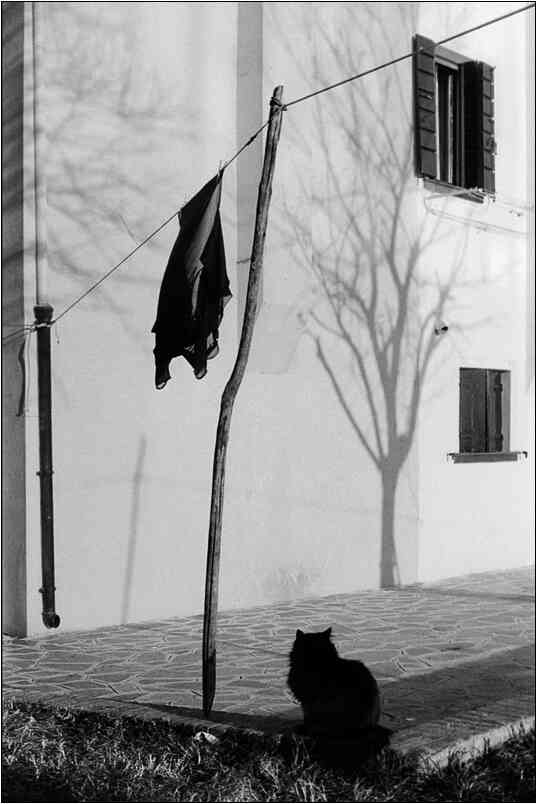
In the Venetian Republic, cats were valued as essential guardians rather than mere domestic pets. As a maritime power built on trade, Venice depended on its merchant fleet and vast grain stores, both constantly threatened by rodents. Cats were commonly kept aboard ships and in warehouses to control rat populations and protect vital supplies.
Introduced through Mediterranean trade routes, including ports of the Eastern Mediterranean, these animals were prized for their hunting instincts and adaptability. Often referred to locally as sorian cats, they became a familiar presence across the city. While much of medieval Europe viewed cats with suspicion, Venice tolerated and protected them for practical reasons. This long coexistence left a quiet but lasting imprint on the character of the lagoon city.
Campo dei Mori, Cannaregio

Campo dei Mori is one of Venice’s most curious and understated squares, hidden in the Cannaregio district near the church of Madonna dell’Orto. Far from the main tourist routes, it reflects a quieter, more residential side of the city, shaped by trade rather than spectacle.
The campo takes its name from a set of striking stone figures embedded in the surrounding façades. According to local tradition, these statues represent three merchant brothers — Rioba, Sandi, and Afani — who arrived in Venice from the eastern Mediterranean in the early Middle Ages and settled in the nearby Palazzo Mastelli del Cammello. One of them, Sior Antonio Rioba, stands at the corner of the square and is recognizable by his iron nose, added centuries later and woven into Venetian folklore.
A fourth figure, traditionally identified as the brothers’ servant, is set slightly apart, embedded in a nearby wall along the Fondamenta dei Mori. Unlike the three merchants, this statue does not represent a member of the Mastelli family.
With its old wellhead and modest scale, Campo dei Mori—much like Campo San Silvestro in the snow—offers a rare glimpse into the legends and long-distance connections that once shaped everyday life in Cannaregio.
San Michele Cemetery

San Michele is Venice’s Island of the Dead, a unique floating cemetery enclosed by high brick walls and lined with slender cypress trees. Seen from across the lagoon, its white Istrian stone façade forms a calm, almost abstract boundary between the living city and a space devoted entirely to memory and silence.
Before the Napoleonic era, Venetians were commonly buried in small parish churchyards scattered throughout the city, a practice that gradually became a serious public health concern. In 1807, under French occupation, authorities decreed that all burials must take place on this dedicated island, marking a decisive shift in the city’s relationship with death and urban space.
The island is home to the church of San Michele in Isola, a Renaissance masterpiece designed by Mauro Codussi and completed in 1469. Today, San Michele serves as the final resting place for generations of Venetians as well as internationally renowned figures such as composer Igor Stravinsky and poet Ezra Pound, reinforcing its role as both a civic and cultural landmark.